
Wine Cooler Running but Not Cooling: What the Symptom Can Mean Before You Replace It

General Appliance Service • October 18, 2026

Share this article

By General Appliance Service

A wine cooler can have a lit display, working interior light, and steady hum while bottles continue getting warmer. That does not automatically mean a failed compressor—or, on a thermoelectric model, a failed cooling assembly. A warm unit needs a methodical check of actual temperature, airflow, installation, and cooling-system type before an expensive part is blamed.

Move valuable wine to a stable, cool location if cabinet temperature is rising. Then evaluate the cooler using temperature readings rather than sound alone.

What a Technician Checks When a Wine Cooler Is Warm

The first step is confirming the complaint. A display may show a selected setting or sensor reading rather than the true temperature throughout the cabinet. A technician compares the setting with a standalone thermometer, notes room temperature, and considers how the cabinet changes over several hours with the door closed.

The model number is also important. Some wine refrigerators use a conventional compressor system, while others use thermoelectric cooling. Both can appear to run without lowering cabinet temperature, but their components and diagnostic paths differ.

Installation is another early check. A freestanding model pushed into cabinetry may not release heat properly. A built-in model also needs its intended intake and exhaust areas open. The technician may inspect fans, controls, sensors, wiring, frost patterns, and the condenser area before recommending parts.

Check Ventilation, Cabinet Airflow, and the Door Seal

Wine coolers remove heat from the cabinet and release it into the surrounding room. When exterior airflow is restricted, the unit may run for long periods with limited cooling performance. Check vents and surrounding space for boxes, towels, pet hair, dust, or cabinet panels that block airflow.

Follow the owner’s manual for clearance requirements. Rear-vented and front-vented models are not installed the same way. Inside the cabinet, avoid packing bottles so tightly that they block circulation openings. Poor internal airflow can create warm zones, although it does not usually explain a completely warm cabinet.

Check that no bottle, shelf, or loose gasket prevents the door from closing. The gasket should be clean, evenly seated, and free of obvious tears. Condensation can suggest warm air entering, but high humidity, frequent openings, or an already-warm cooler can cause similar moisture.

Homeowners needing appliance repair in Flagler Beach should confirm actual cabinet temperature and installation airflow before assuming cooling parts need replacement.

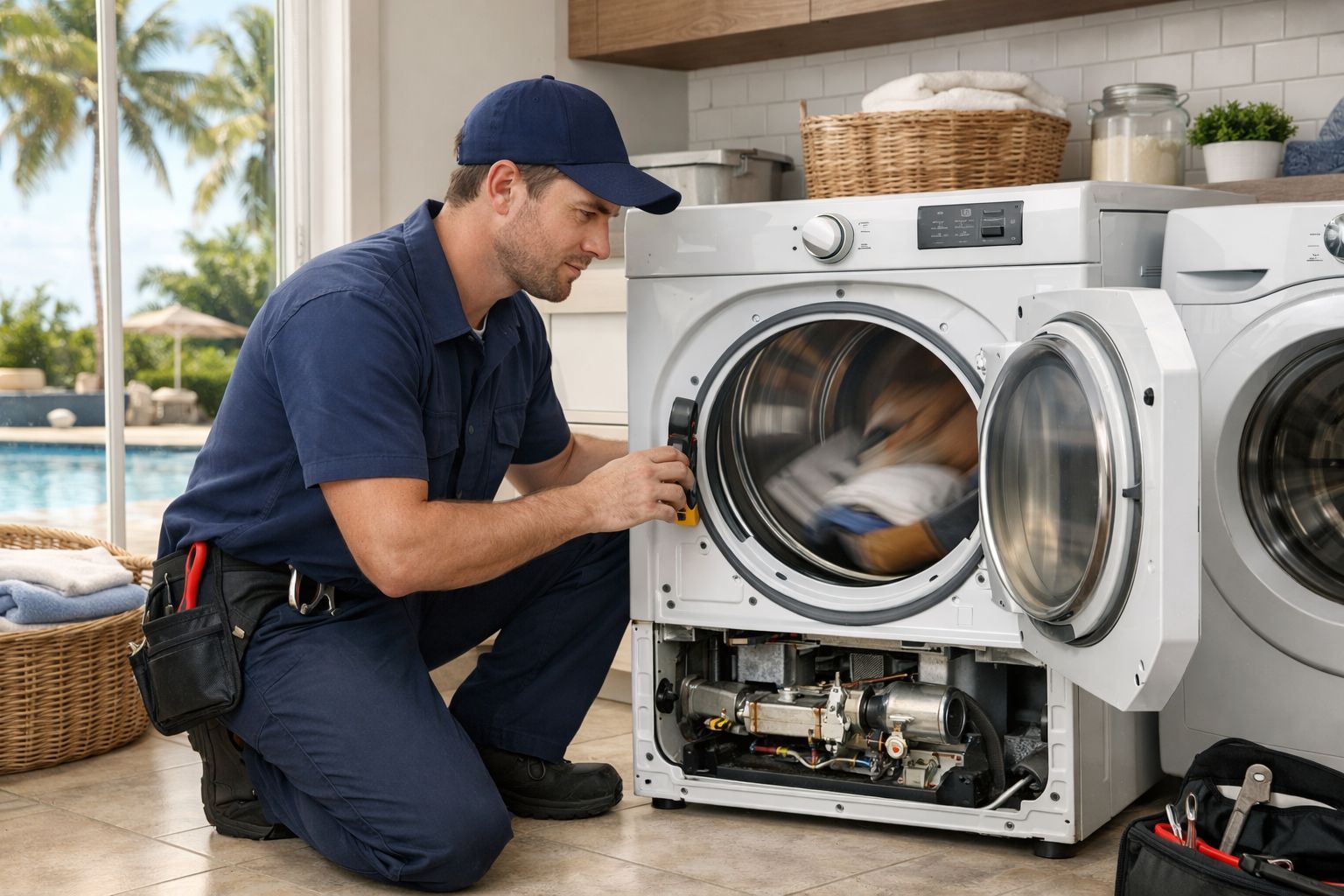
Illustrative appliance diagnostic inspection
AI-generated illustration of an appliance inspection.

Why a Running Cooler May Still Fail to Cool

On a compressor-based wine cooler, a hum or vibration may mean the compressor is attempting to operate. It does not prove the appliance is transferring heat correctly or producing enough cooling inside the cabinet.

Fan problems are common possibilities. Depending on the model, a condenser fan, evaporator fan, or both may be necessary. A fan can be obstructed, noisy, intermittent, or electrically inactive. The compressor may still run while heat exchange or internal air movement is inadequate.

Control, sensor, wiring, and start-circuit faults can overlap with cooling-system symptoms. A failed control board may leave the cabinet warm, but incorrect information from a sensor can produce a similar result. Proper diagnosis includes verifying power, component response, and manufacturer-specific operating behavior.

For compressor models, technicians may also assess frost patterns and overall cooling performance. Refrigerant tubing should never be pierced or “topped off” as a homeowner repair. Sealed-system work requires appropriate equipment and diagnosis.

Thermoelectric Models and Electrical Safety

Thermoelectric wine coolers do not use compressors. They rely on a thermoelectric cooling assembly and fans to move heat away from the cabinet. If fans cannot move air, controls are not operating correctly, or the cooling assembly has failed, the unit may have power but remain warm.

These models can be especially affected by room temperature. A cooler in a hot garage, sunny room, or poorly ventilated enclosure may struggle even when no individual component has failed.

General Appliance Service can evaluate cooler type, installation, controls, fans, and model support before discussing wine cooler repair in Palm Coast. Parts availability and repair feasibility depend on the exact unit and confirmed fault.

Stop using the cooler and seek prompt service if you notice smoke, burning odor, cord damage, sparking, or repeated breaker trips. Do not use compressor temperature as a diagnosis; hot components can be normal and unsafe to touch.

Frequently Asked Questions About a Wine Cooler Running but Not Cooling

Why is my wine cooler running but not getting cold?

Restricted ventilation, door-seal issues, fan trouble, sensor or control faults, and cooling-system problems can all cause this symptom. Compressor and thermoelectric models require different checks.

Can blocked vents make a built-in wine cooler run warm?

Yes. If the unit cannot draw in or exhaust air as designed, it cannot release heat efficiently. Remove obstructions and follow the manufacturer’s clearance requirements.

Why does my wine fridge have lights but no cooling?

Lights and displays show that part of the electrical system has power. Fans, controls, the compressor circuit, or the thermoelectric assembly may still have a separate fault.

Is a warm wine cooler always a bad compressor?

No. A running compressor does not prove proper cooling, but it does not prove compressor failure either. Airflow, fans, sensors, controls, and heat exchange should be checked first.

Should I unplug a wine cooler that runs constantly?

Move the wine elsewhere and monitor cabinet temperature. Unplug the unit promptly if you notice smoke, burning odors, damaged wiring, breaker trips, sparking, or other abnormal electrical behavior.

Accurate temperature readings, clear airflow, and the cooler’s system type provide the best starting point. A focused inspection can identify simple installation issues or confirm when professional repair is appropriate.

Recent Posts

By General Appliance Service • November 18, 2026
Learn why a gas dryer heats then blows cold air later in the cycle, what burner cycling is normal, and when delayed heat loss needs diagnosis.
By General Appliance Service • November 17, 2026
Is your electric oven taking too long to preheat? Learn what can cause slow heating, why the display may be misleading, and when professional diagnosis is needed.
Washer fills with water when turned off
November 16, 2026
Why does your washer fill with water when turned off? Learn how inlet-valve seepage differs from drain backflow, what to shut off safely, and when to call a technician.
By General Appliance Service • November 15, 2026
Learn why a front load washer smells musty after cleaning, what homeowners can safely check, and when drainage or residue problems need professional diagnosis.
By General Appliance Service • November 14, 2026
An electric stove burner that stays on high is a temperature-control problem. Learn what may cause it, what to check safely, and when to stop using the range.
By General Appliance Service • November 13, 2026
A refrigerator fan noise that stops when the door opens may involve normal fan timing, frost contact, or a failing motor. Learn what to check safely.
By General Appliance Service • November 12, 2026
A dishwasher knocking noise during the wash cycle may be caused by spray-arm contact or a wash-system problem. Learn what to check safely and when repair is needed.
By General Appliance Service • November 11, 2026
Gas dryer rattles only when heating? Learn what a heat-only buzz or chatter can indicate, what to check safely, and when to call for dryer repair.
By General Appliance Service • November 10, 2026
Learn why an oven display resets when heating, what homeowners can safely check, and when a heat-related power loss needs professional diagnosis.
By General Appliance Service • November 7, 2026
Washer leaving grease spots on clothes? Learn how detergent buildup, laundry contaminants, and internal washer problems can create dark marks.
Show More