Why the Broil Element Turns On During Bake in an Electric Oven

General Appliance Service • October 16, 2026

Share this article

By General Appliance Service

If the broil element turns on during Bake, it may seem like your electric oven has selected the wrong function. In many modern electric ranges, however, upper-element cycling is normal, especially during preheat. The more important question is whether the oven reaches and maintains the selected temperature while cooking food evenly.

Bake does not always mean the lower element operates alone. Electronic controls may use both elements in a model-specific sequence to heat the cavity efficiently and reduce temperature differences.

What a Technician Checks

A technician first confirms how the specific oven is designed to operate. Some models use the bake element most of the time, while others briefly cycle the broil element during preheat or throughout the baking cycle. Convection settings may also change which elements operate and when.

Next, the technician evaluates oven performance. Does it preheat within a reasonable time? Does it stabilize near the selected temperature? Is food taking too long, browning unevenly, or burning on top? A glowing broil element by itself does not prove that a relay, selector switch, or control board has failed.

Testing focuses on the heating elements, wiring connections, temperature sensor, control outputs, and incoming electrical supply. This process separates normal control logic from a genuine heating or electrical problem.

When Upper-Element Cycling Is Normal

Preheat requires the oven to warm the air, racks, walls, and interior surfaces. Using upper and lower heat can help the cavity reach temperature faster and more evenly. Once preheat is complete, the elements may continue cycling on and off as the control maintains the selected temperature.

You may see the broil element glow briefly, turn off, and later cycle back on during Bake. That does not necessarily mean the oven has switched itself to Broil. It may simply be following its programmed heating sequence.

Element color is also not a complete performance test. A bright element can be operating normally, while an oven with a sensor, wiring, or power problem may still heat poorly. Conversely, normal cycling can look concerning even when the oven is working as designed.

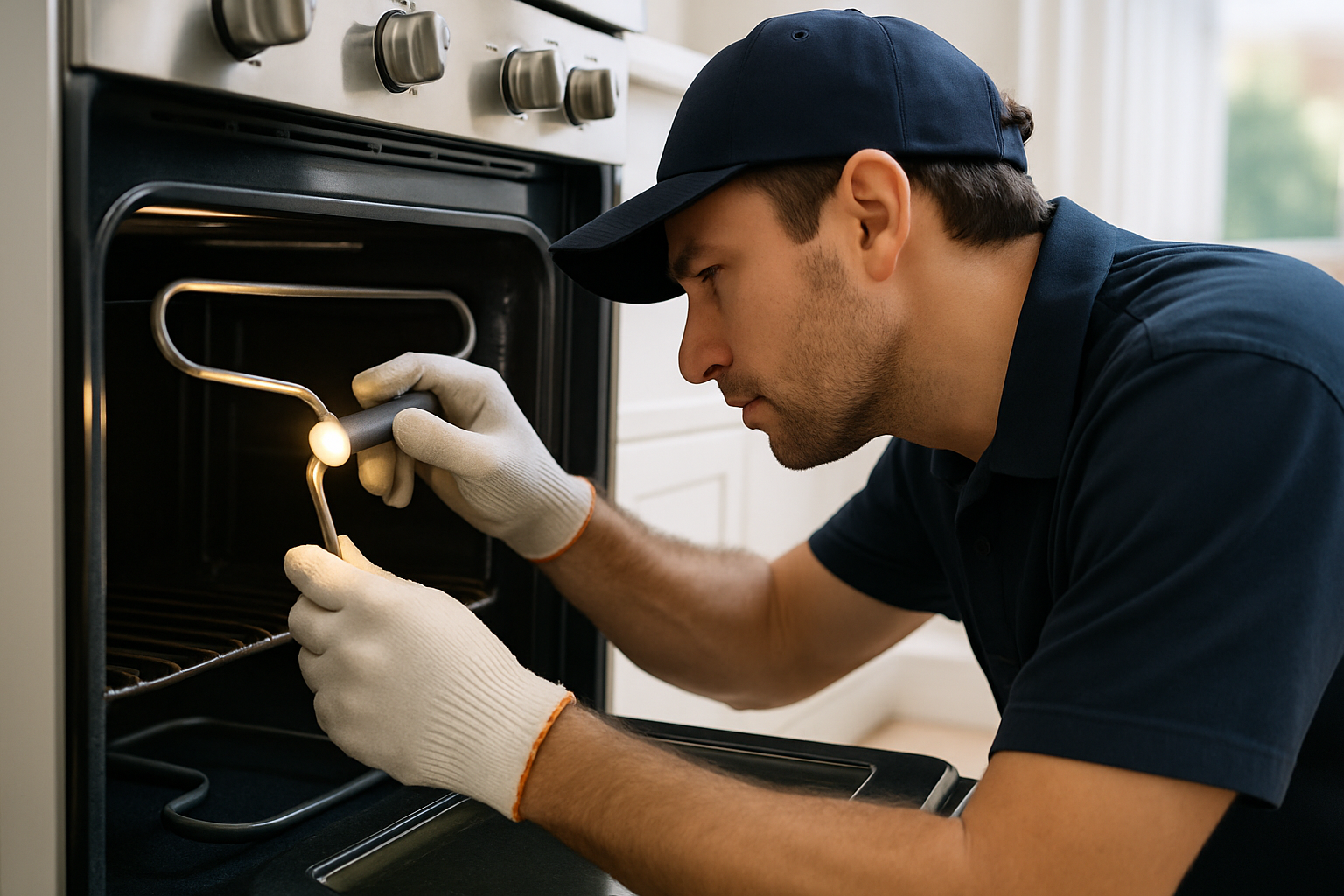
Illustrative appliance diagnostic inspection
AI-generated illustration of an appliance inspection.

Signs the Oven Has a Heating Problem

Further diagnosis is warranted when the broil element comes on during Bake and the oven performs poorly. Slow preheat, temperatures that remain far below the setting, repeated undercooking, or excessive top browning can point to a fault.

A weakened or failed bake element is a common cause. The broil element may still work, allowing the oven to become somewhat warm without properly reaching or maintaining temperature. Loose, heat-damaged, or burned element terminals can create similar symptoms.

Other possible causes include an inaccurate temperature sensor, a failed relay or control output, or an incoming power issue. Electric ranges typically require a 240-volt circuit, and a supply problem can leave the display, light, fan, or one heating element operating while preventing full oven performance.

For heating, temperature, or electrical concerns, Palm Coast oven and range repair can identify the failed part or circuit before expensive components are replaced unnecessarily.

Safe Checks Before Scheduling Service

Confirm that Bake—not Broil, Convection Broil, or another mode—was selected. Set a normal baking temperature, keep the door closed, and allow the oven its usual preheat time. Note whether the issue occurs in standard Bake, Convection Bake, or both.

An oven thermometer can provide a general observation, although it cannot precisely diagnose a sensor or control fault. With the oven off and cool, inspect the elements without touching them. A split, blistered, warped, or sparking element is not normal.

Stop using the oven if you notice smoke, arcing, repeated breaker trips, an error code, or a burning-electrical smell. Do not remove panels or attempt live-voltage, resistance, or amperage tests. Those checks can involve energized 240-volt circuits and require model-specific procedures.

For St. Johns County homeowners, St. Augustine appliance repair is available for oven issues beyond normal cycling. Brand-specific service is also available through Frigidaire appliance repair in Palm Coast.

Frequently Asked Questions About a Broil Element That Turns On During Bake

Is it normal for the top element to glow during Bake?

Often, yes. Many electric ovens use the broil element during preheat and may cycle it afterward to help maintain cavity temperature.

Why does my oven use the broil element while preheating?

Upper and lower heat can speed preheat and improve heat distribution. This does not automatically mean the oven has entered Broil mode.

Does a glowing broil element mean the control board is bad?

No. Normal oven logic may energize it during Bake. Elements, wiring, sensors, power supply, and control outputs require testing first.

What if the oven never reaches temperature?

That is not normal. A failed bake element, damaged terminal, sensor issue, relay fault, control problem, or power-supply issue may be involved.

Should I use an oven with a damaged element or burning smell?

No. Stop using it if you see arcing, smoke, breaker trips, or a split element. These symptoms can indicate an electrical hazard.

Have the model number, selected mode, temperature setting, timing observations, and error messages ready when calling General Appliance Service at (386) 359-3215.

Recent Posts

By General Appliance Service • October 15, 2026
A gas oven that preheats but cools down during baking may have an ignition, flame, sensor, or control issue. Learn what is normal and when to stop using it.
By General Appliance Service • October 14, 2026
A washer that bangs during the spin cycle with towels or blankets may have an uneven load, installation issue, or developing mechanical problem. Learn what to check safely.
By General Appliance Service • October 13, 2026
Is your dishwasher leaving dishes wet after a completed cycle? Learn what is normal, what to check safely, and when poor drying needs professional diagnosis.
By General Appliance Service • October 12, 2026
Refrigerator clicking but not cooling? Learn what repeated clicking can mean, what to check safely, and when professional diagnosis is needed.
By General Appliance Service • October 11, 2026
If your dryer shuts off mid-cycle but restarts after cooling down, learn what airflow, motor, door switch, power, and control problems a technician may check.
By General Appliance Service • October 10, 2026
Wine cooler icing up and running constantly? Learn what frost, long run times, door seals, ventilation, sensors, and cooling-system problems can mean.
By General Appliance Service • October 9, 2026
An ice maker overflowing can freeze the bin, create leaks, and point to a valve, fill-tube, or control problem. Learn what to check safely.
By General Appliance Service • October 8, 2026
Freezer frosting near the door often points to humid air entering the cabinet, but airflow and defrost problems can look similar. Learn what to check safely.