
Why Is My Refrigerator Clicking Every Few Minutes but Not Cooling?

General Appliance Service • October 12, 2026

Share this article

By General Appliance Service

A refrigerator that clicks every few minutes but is not cooling needs attention, especially when compartment temperatures are rising. The click is an important clue, but it does not identify one failed part on its own. Its timing, location, and what happens immediately afterward help narrow the diagnosis.

Protect food first. Keep doors closed, check temperatures with a thermometer, and move meat, dairy, leftovers, and thawing items to dependable cold storage if temperatures are climbing.

What a Technician Checks When a Refrigerator Clicks but Will Not Cool

A technician confirms the cooling symptom before assuming the compressor has failed. Refrigerator and freezer temperatures are measured, then the unit is observed during a cooling call. Does it click, hum briefly, and go quiet? Does the compressor continue running after the click? Or does it run constantly without lowering temperatures?

These patterns lead to different diagnostic paths. A click followed by a short hum and silence may involve the compressor start circuit, compressor, wiring, or control system. A refrigerator that runs continuously but remains warm may instead have airflow restrictions, frost buildup, condenser trouble, or a sealed-system concern.

The sound’s location also matters. Clicking near the lower rear may come from the compressor area, condenser fan, start components, or electrical controls. A click inside the fresh-food compartment can have a different source.

Check Temperatures and Airflow Before Blaming the Compressor

Digital displays and interior lights do not confirm proper cooling. Record actual refrigerator and freezer temperatures with an appliance thermometer. If the freezer remains cold while the refrigerator section is warm, an air circulation issue may be more likely than a complete cooling failure.

Condenser airflow is another important check. The condenser must release heat, and many models use a fan near the compressor to move air across those components. If that fan is not operating during a cooling call, the compressor can overheat and struggle to run.

From a safe distance, you may be able to see whether the rear fan is spinning through an opening or grille. Do not reach through a grille, remove rear panels, or touch compressor-area components. For refrigerator repair in Palm Coast, temperature readings and fan observations provide useful diagnostic details.

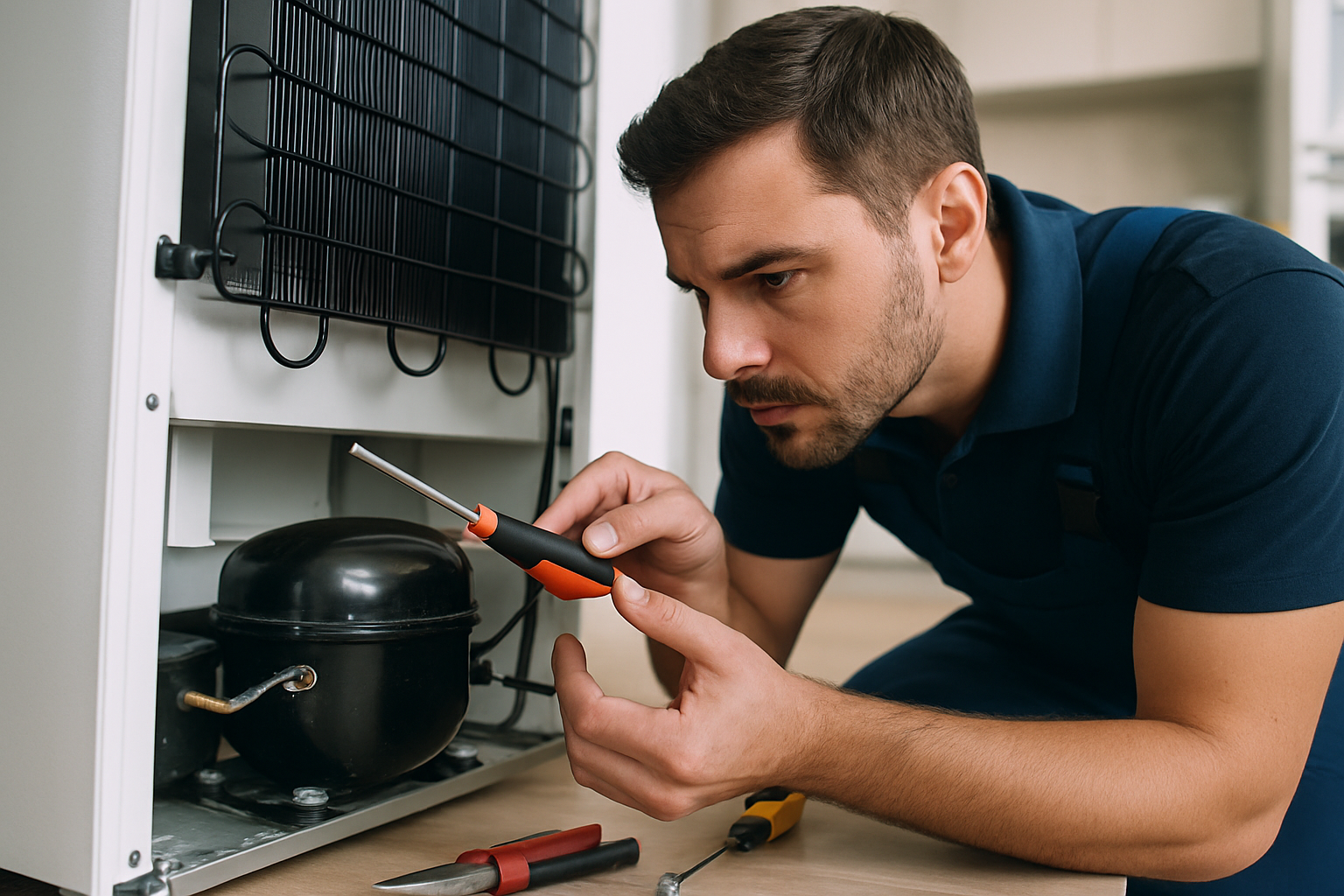
Illustrative appliance diagnostic inspection
AI-generated illustration of an appliance inspection.

Why a Start Device Is Not Always the Answer

The start device and overload protector help the compressor start safely. A failed start component can cause repeated clicking, often with a brief hum before the compressor shuts down. However, replacing a relay or start device without testing can waste money and miss the actual problem.

Similar symptoms can occur when the compressor draws abnormal current, a connection is damaged, a control board is not sending proper output, or the compressor has an internal electrical failure. A sensor or wiring issue may also cause the control system to cycle incorrectly.

Technicians inspect connections, test start components, verify condenser-fan operation, and evaluate compressor electrical behavior using model-specific procedures. They may also inspect evaporator-fan operation, frost patterns, defrost performance, and air passages. Do not install a hard-start kit, bypass an overload, swap relays randomly, or attempt live-voltage testing.

When Repeated Clicking Needs Prompt Service

Arrange service promptly when clicking is accompanied by rising temperatures. Repeated restart attempts can stress electrical components while food remains at unsafe temperatures.

Stop using the refrigerator and seek help if you notice smoke, a burning odor, a hot plug or outlet, damaged wiring, or repeated breaker trips. These signs are not normal cooling symptoms and can indicate an electrical hazard.

General Appliance Service helps homeowners throughout St. Johns, Flagler, and Volusia counties diagnose refrigerator problems without guessing at parts. If a refrigerator is clicking and warming near the coast, appliance repair in St. Augustine Beach can help identify whether the issue involves airflow, controls, the start circuit, or the compressor system.

Frequently Asked Questions About a Refrigerator Clicking but Not Cooling

Why does my refrigerator click every few minutes but stay warm?

It may be trying unsuccessfully to start the compressor, or a control-related component may be cycling. Compressor behavior, fan operation, and temperatures determine the cause.

Does clicking always mean the compressor is bad?

No. A defective start device, condenser-fan problem, wiring fault, control issue, or airflow restriction can also cause clicking and poor cooling.

Should I unplug a refrigerator that keeps clicking?

Unplug it safely if there is smoke, burning odor, a hot outlet, damaged wiring, or breaker trips. Otherwise, protect food and schedule prompt diagnosis.

Can dirty coils or a failed fan cause clicking?

Restricted condenser airflow can cause overheating and poor cooling. A failed fan can worsen the condition, but testing is needed to identify the click’s source.

What should I tell a refrigerator repair technician?

Provide the model number, refrigerator and freezer temperatures, click frequency, whether a hum follows, error codes, outage history, and visible fan activity.

Have the model number, temperature readings, error codes, and details about the clicking pattern ready when you call (386) 359-3215. Clear observations help a technician diagnose the refrigerator efficiently and recommend an appropriate repair.

Recent Posts

By General Appliance Service • October 14, 2026
A washer that bangs during the spin cycle with towels or blankets may have an uneven load, installation issue, or developing mechanical problem. Learn what to check safely.
By General Appliance Service • October 13, 2026
Is your dishwasher leaving dishes wet after a completed cycle? Learn what is normal, what to check safely, and when poor drying needs professional diagnosis.
By General Appliance Service • October 11, 2026
If your dryer shuts off mid-cycle but restarts after cooling down, learn what airflow, motor, door switch, power, and control problems a technician may check.
By General Appliance Service • October 10, 2026
Wine cooler icing up and running constantly? Learn what frost, long run times, door seals, ventilation, sensors, and cooling-system problems can mean.
By General Appliance Service • October 9, 2026
An ice maker overflowing can freeze the bin, create leaks, and point to a valve, fill-tube, or control problem. Learn what to check safely.
By General Appliance Service • October 8, 2026
Freezer frosting near the door often points to humid air entering the cabinet, but airflow and defrost problems can look similar. Learn what to check safely.